



 857 / 912

Chapter 28 849
Copyright © 2017 Pearson Education, Inc.
2.
a.
bonding orbitals
=
c
1
,
c
2
,
c
3
; antibonding orbitals
=
c
4
,
c
5
,
c
6
b.
ground-state HOMO
=
c
3
; ground-state LUMO
=
c
4
c.
excited-state HOMO
=
c
4
; excited-state LUMO
=
c
5
d.
symmetric orbitals
=
c
1
,
c
3
,
c
5
; antisymmetric orbitals
=
c
2
,
c
4
,
c
6
e.
The HOMO and LUMO have opposite symmetries.
3.
a.
eight molecular orbitals
b.
c
4
c.
seven nodes (There is also a node that passes through the
nuclei—that is, through the centers of the
p
orbitals.)
4.
a.
1,3-Pentadiene has two conjugated
p
bonds, so it has the same molecular orbital description as
1,3-butadiene, a compound that also has two conjugated
p
bonds. (See Figure 28.2 on page 1216 of
the text.)
b.
The
p
bonds in 1,4-pentadiene are isolated, so its molecular orbital description is the same as ethene, a
compound with an isolated
p
bond. (See Figure 28.1 on page 1216 of the text.)
c.
1,3,5-Heptatriene has three conjugated
p
bonds, so it has the same molecular orbital description as
1,3,5-hexatriene, a compound that also has three conjugated
p
bonds. (See Figure 28.3 on page 1217
of the text.)
d.
1,3,5,8-Nonatetraene has three conjugated
p
bonds and an isolated
p
bond. The three conjugated
p
bonds are described by Figure 28.3 and the isolated
p
bond by Figure 28.1.
5.
a.
2, 4, or 6 conjugated double bonds
3, 5, or 7 conjugated double bonds
b.
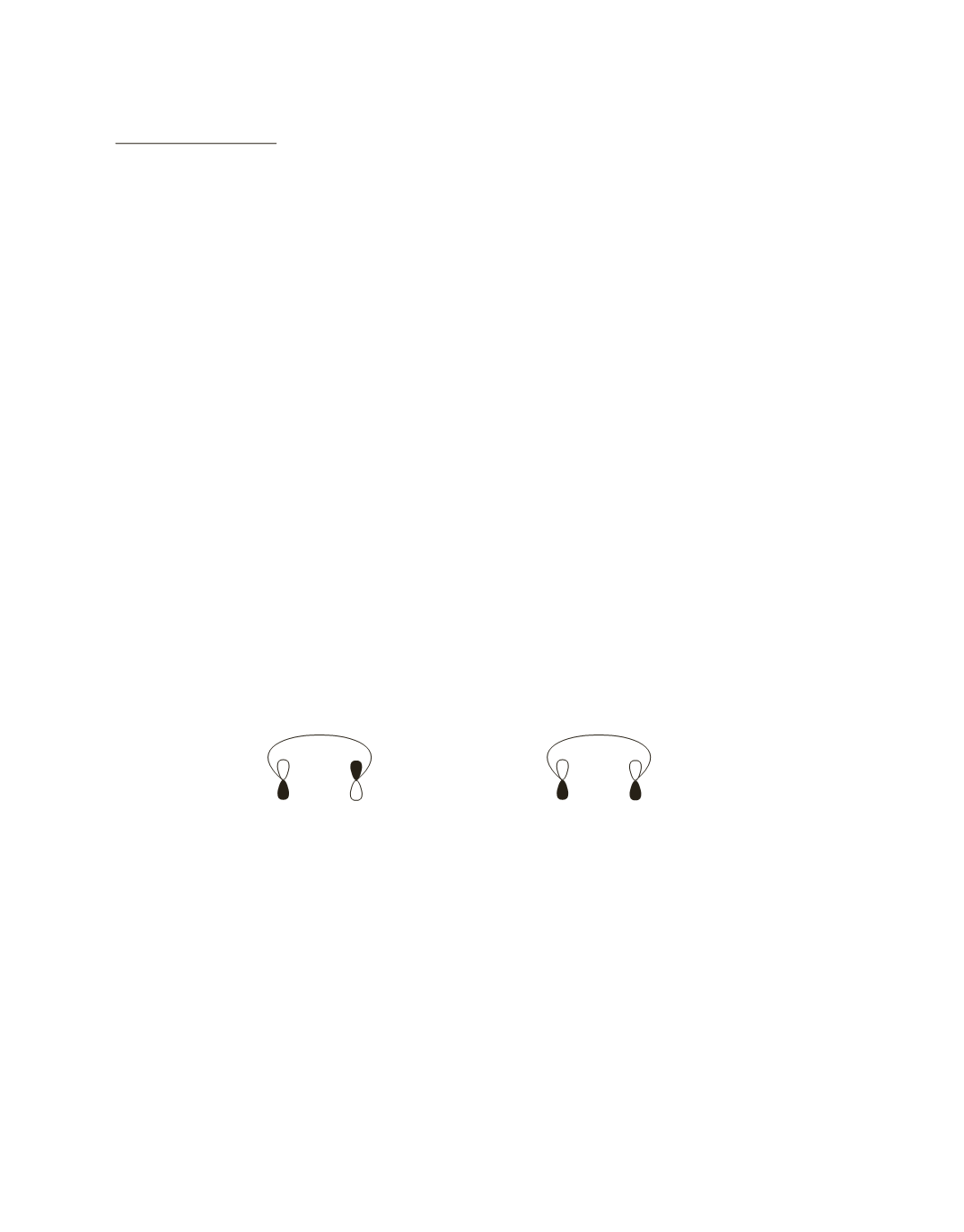
Under thermal conditions, electrocyclic ring closure involves the HOMO of the polyene (a compound
with several double bonds). If the polyene has an even number of double bonds, conrotatory ring
closure will result in in-phase overlap of the terminal
p
orbitals in the HOMO. If the polyene has an
odd number of double bonds, disrotatory ring closure will result in in-phase overlap of the terminal
p
orbitals in the HOMO.
Under photochemical conditions, electrocyclic ring closure involves the LUMO of the polyene, which
has the opposite symmetry of the HOMO and, therefore, requires the opposite mode of ring closure to
that required under thermal conditions.
6.
a.
(2
E
,4
Z
,6
Z
,8
E
)-2,4,6,8-Decatetraene has an even number of conjugated
p
bonds (4). Therefore, under
thermal conditions, ring closure will be conrotatory.
b.
The substituents point in opposite directions, and conrotatory ring closure of such substituents will
cause them to be trans in the ring-closed product.
Solutions to Problems
1.
a.
electrocyclic reaction
b.
sigmatropic rearrangement
c.
cycloaddition reaction
d.
cycloaddition reaction