



 829 / 912

Chapter 26 821
Copyright © 2017 Pearson Education, Inc.
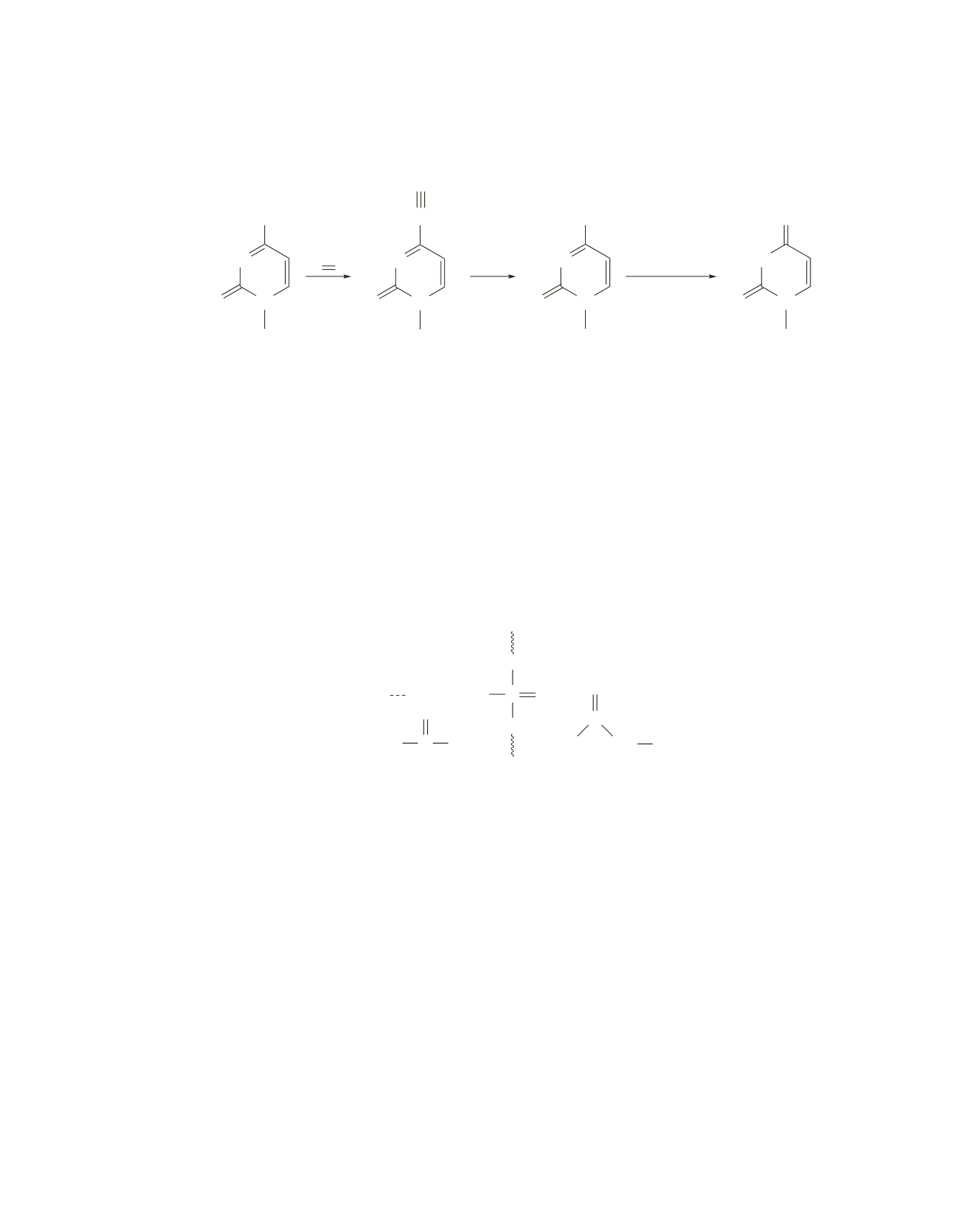
The nitrosonium ion reacts with a primary amino group to form a diazonium ion, which can be displaced
by water (Section 18.18).
N
N
NH
2
O
N
N
N
O
N
+
+
N
N
OH
O
H
2
O
HN
N
O
O
tautomerization
cytosine
uracil
N O
38.
It requires energy to break the hydrogen bonds that hold the two chains together, so an enormous amount
of energy would be required to unravel the chain completely.
As the new nucleotides that are incorporated into the growing chain form hydrogen bonds with the parent
chain, energy is released, and this energy can be used to unwind the next part of the double helix.
39.
Ca
2
+
decreases the p
K
a
of water, forming calcium-bound hydroxide ion, which is a better nucleophile than
water. The positively charged nitrogen (of the guanidinium group) of arginine stabilizes the negatively
charged oxygen formed when the P
“
O
p
bond of the diester breaks and therefore makes it easier to
form. Glutamic acid protonates the OR oxygen, thereby making it a weaker base and, therefore, a better
leaving group when the P
“
O
p
bond reforms.
Ca
+
+
OH
P O
Glu
OH
O
H
2
N
NH
2
NH
O
C
O
δ −
−
O
C