



 828 / 912

820 Chapter 26
Copyright © 2017 Pearson Education, Inc.
b.
The mRNA for the mutant peptide has an unused 3 -terminal two-letter code, U(UCAG). The
last amino acid in the octapeptide of the normal fragment is leucine, so its last triplet is UU(AG)
or CU(UCAG).
This means that the triplet for the last amino acid in the mutant is U(UCAG)(UC) and that the last amino
acid in the mutant is one of the following: Phe, Ser, Tyr, or Cys.
35.
If deamination does not occur, the mRNA sequence will be:
AUG–UCG–CUA–AUC, which will code for the following tetrapeptide:
Met-Ser-Leu-Ile
Deamination of a cytosine results in a uracil.
If the cytosines are deaminated, the mRNA sequence will be:
AUG–UUG–UUA–AUU, which will code for the following tetrapeptide:
Met-Leu-Leu-Ile
The only cytosine that would change the amino acid that is incorporated into the peptide is the first one.
Therefore, this is the cytosine that could cause the most damage to an organism if it were deaminated.
36.
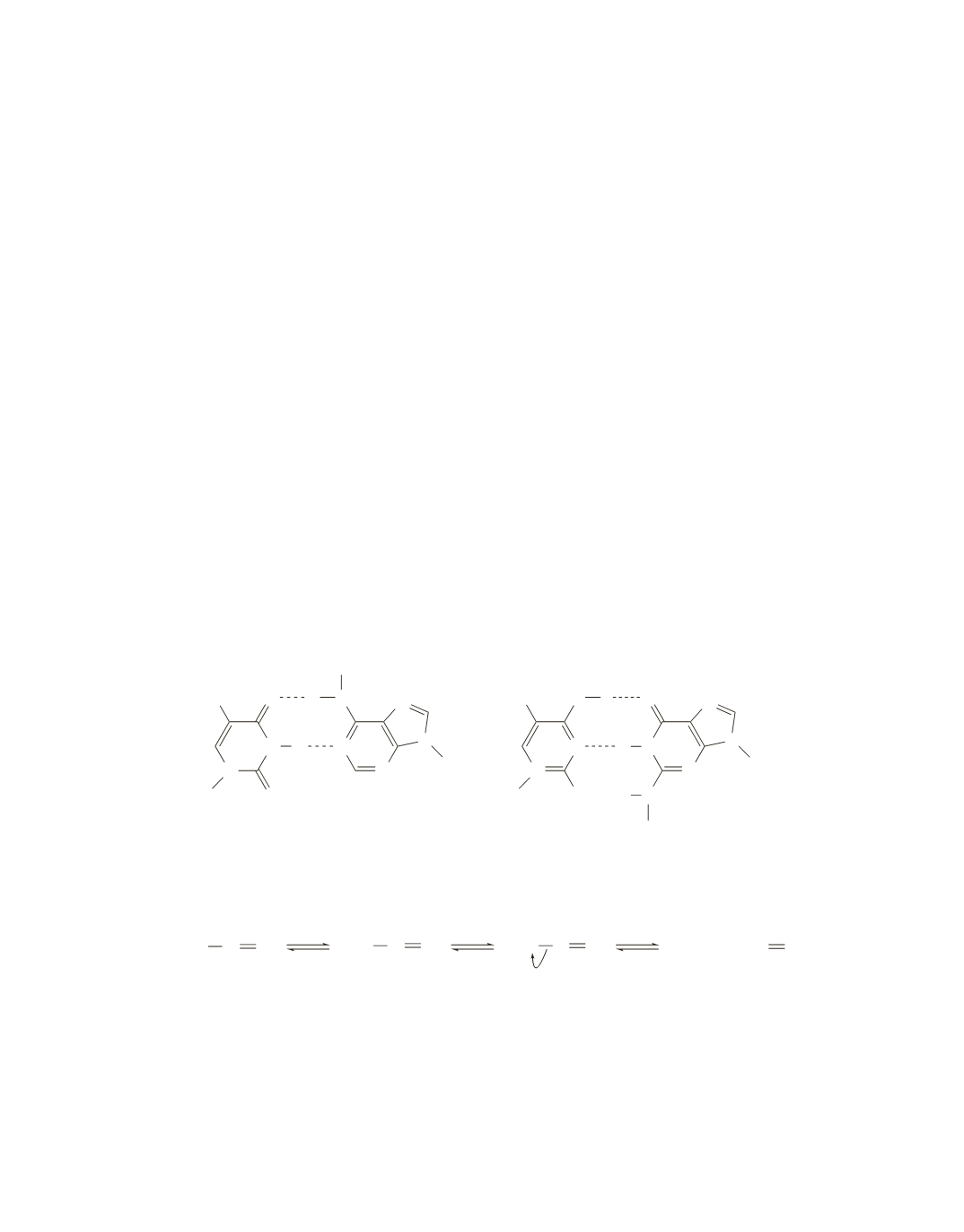
5-Bromouracil is incorporated into DNA in place of thymine because of their similar size. Thymine exists
primarily in the keto form and pairs with adenine via two hydrogen bonds. 5-Bromouracil exists primarily
in the enol form. The enol cannot form any hydrogen bonds with adenine, but it can form two hydrogen
bonds with guanine. Therefore, 5-bromouracil pairs with guanine. Because 5-bromouracil causes guanine
to be incorporated instead of adenine into newly synthesized DNA strands, it causes mutations.
N
H
3
C O
sugar
O
H N
H
H N
N
N
sugar
thymine
adenine
N
Br
O
sugar
OH
H O
H N
H N
N
N
sugar
5-bromouracil
guanine
H
N
N
N
N
37.
In an acidic environment, nitrite ion is protonated to nitrous acid. We have seen that the nitrosonium ion is
formed from nitrous acid (Section 18.20).
Na
+
N O
−
O
HCl
HO
HCl
+
Cl
−
sodium nitrite
N O
HO
+
Cl
−
H
+
H
2
O
+
+
nitrosonium
ion
N O
N O