



 827 / 912

Chapter 26 819
Copyright © 2017 Pearson Education, Inc.
Because 20 amino acids must be specified, a two-letter code does not provide enough codons.
A three-letter code provides enough codons for all the amino acids and also provides the necessary stop
codons.
A four-letter code provides many more codons than are needed.
33.
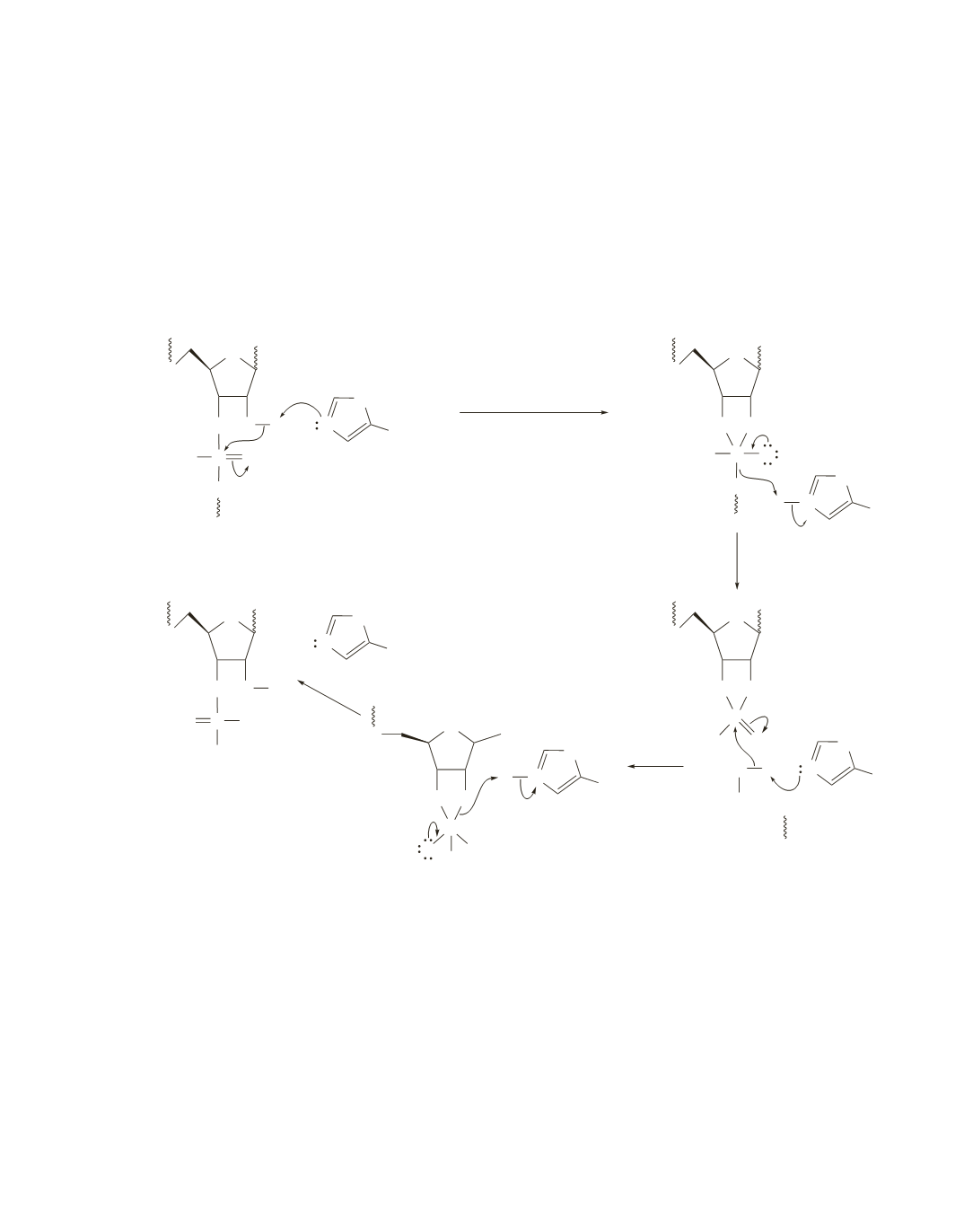
In the first step of the reaction, the imidazole ring of one histidine acts as a general-base catalyst, removing
a proton from the 2
@
OH group to make it a better nucleophile. In the second step, the imidazole ring of
the other histidine acts as a general-acid catalyst, protonating the leaving group to make it a weaker base
and, therefore, a better leaving group. In the third and fourth steps, the roles of the two imidazole rings are
reversed.
O
O O H
P
−
O O
O
NH
N
His
O
O O
P
−
O O
O
NH
N
His
−
H
+
O
O O H
PO O
−
OH
NH
N
O
O O
P
−
O O
NH
N
His
O
H
H
OH
P
O
−
His
O
O
O O
OH
NH
N
His
O
−
H
O
O
O
O
34.
The normal and mutant peptides have the following base sequence in their mRNA:
normal: CA(AG) UA(UC) GG(UCAG) AC(UCAG) CG(UCAG) UA(UC) GU(UCAG)
mutant: CA(AG) UC(UCAG) GA(AG) CC(UCGA) GG(UCGA) AC(UCAG)
a.
The middle nucleotide (A) in the second triplet was deleted. This means that an A was deleted in the
sense strand of DNA or a T was deleted in the template strand of DNA.