



 773 / 912

Chapter 23 765
Copyright © 2017 Pearson Education, Inc.
20.
HCO
3
−
, ATP, Mg
2
+
propionyl-CoA
propionyl-CoA
carboxylase
biotin
methylmalonyl-CoA
mutase
coenzyme B
12
succinyl-CoA
_
COO
SCoA
CH
3
CH
2
C
O
SCoA
CH
3
CH
C
O
_
COO
SCoA
CH
2
CH
2
C
O
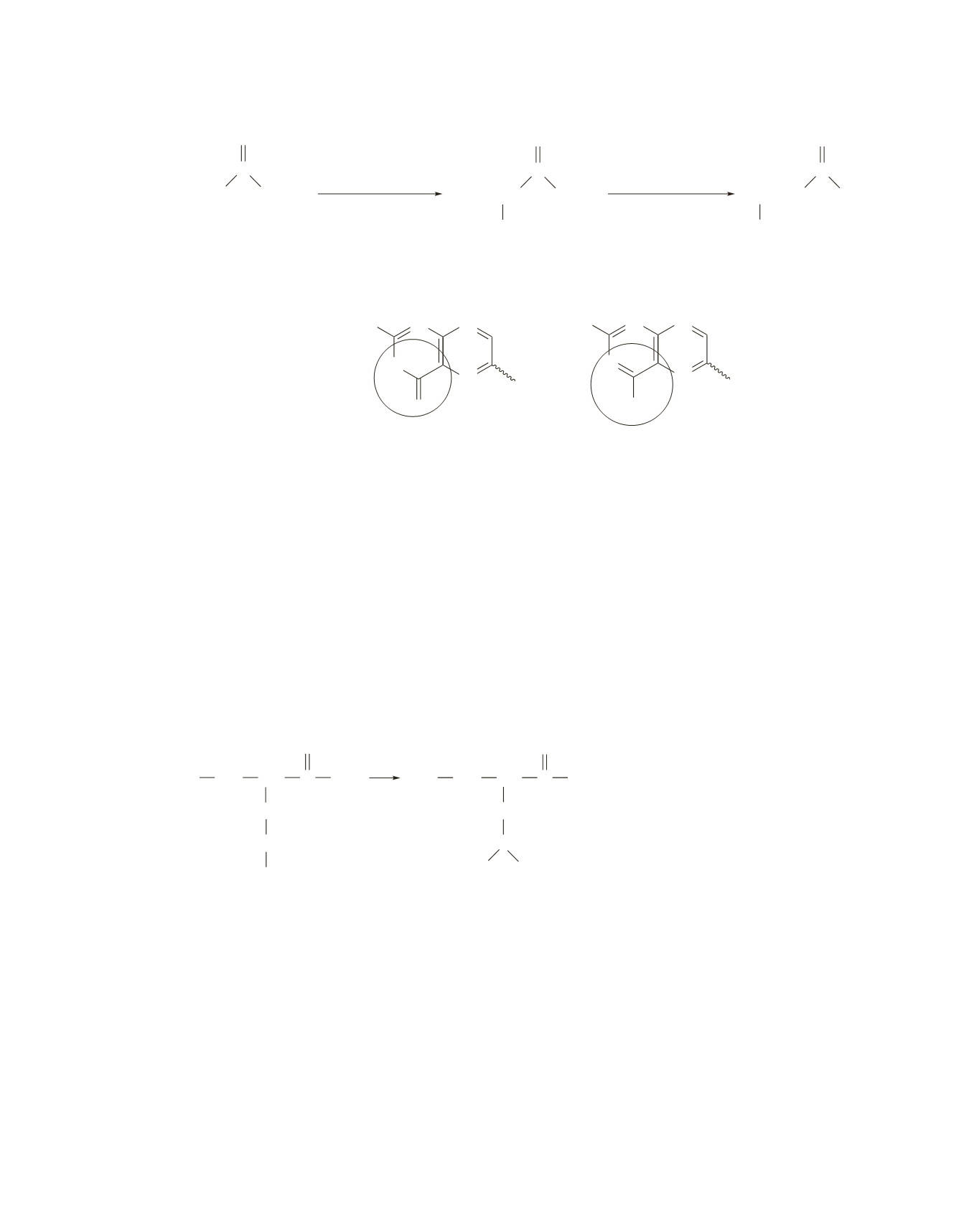
21.
They differ only in the circled part of the molecule.
H
2
N
O
N
HN
N
folic acid
aminopterin
N
H
2
NH
2
N N
N
N
N
22.
The methyl group in thymidine comes from the methylene group of
N
5
,
N
10
-methylene-THF, followed by the
addition of a hydride ion from the coenzyme. The methylene group of
N
5
,
N
10
-methylene-THF comes from
the
CH
2
OH
group of serine by means of a PLP-catalyzed
C
a
:
C
b
cleavage. (See page 1082 in the text.)
23.
Two thiol groups are oxidized in each of the two reactions that overall reduces vitamin K epoxide to
vitamin
KH
2
.
Because dihydrolipoate has two thiol groups, each thiol oxidation involves an intramolecular
reaction. When thiols such as ethanethiol or propanethiol are used, each thiol oxidation involves an
intermolecular reaction. These thiols react more slowly than dihydrolipoate, because the two thiol groups
are not in the same molecule. Therefore, they have to find each other to react.
24.
a.
thiamine pyrophosphate
b.
FAD oxidizes dihydrolipoate back to lipoate.
c.
NAD
+
oxidizes
FADH
2
back to FAD.
d.
NH CH C
O
CH
2
CH
2
COO
−
NH CH C
O
CH
2
−
−
COO
OOC
CH
e.
thiamine pyrophosphate and pyridoxal phosphate
f.
Thiamine pyrophosphate is used for the decarboxylation of
a
-keto acids.
Pyridoxal phosphate is used for the decarboxylation of amino acids.
g.
biotin and vitamin
KH
2
h.
Biotin carboxylates a carbon adjacent to a carbonyl group (that is, an
a
-carbon).
Vitamin
KH
2
carboxylates the
g
-carbon of a glutamate.
25.
a.
thiamine pyrophosphate, carboxybiotin, pyridoxal phosphate
b.
NAD
+
, NADP
+
, FAD
c.
vitamin
KH
2
d.
N
-substituted tetrahydrofolate