


 569 / 912

Chapter 17 561
Copyright © 2017 Pearson Education, Inc.
10.
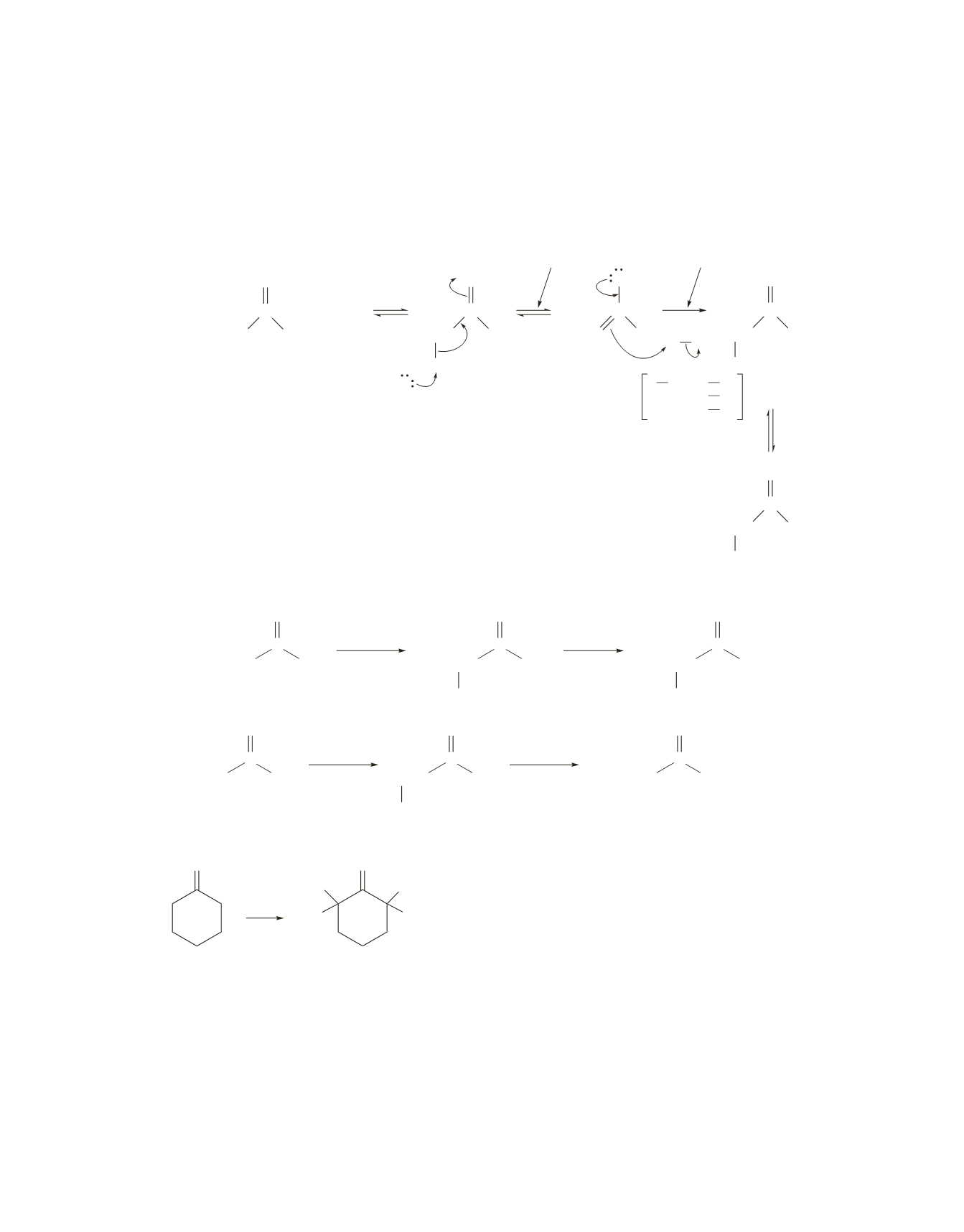
A Br—Br bond is weaker and easier to break than a Cl—Cl bond, which in turn is weaker and easier to
break than a D—O bond. Because the experimentally determined rates of bromination, chlorination, and
deuterium exchange are about the same, you know that breaking the Br—Br, Cl—Cl, or D—O bond,
which occur at different rates, takes place after the rate-determining step. Therefore, the rate-determining
step must be removal of the proton from the
a
-carbon of the ketone.
H
3
O
+
+
H
3
O
+
+
X Y
rate-determining step rate of this step varies
+
+
X
−
or
−
OD
H
2
O
RCH
2
R
C
O
RCH
OH
R
+
C
RCH
OH
R
C
RCH
OH
R
Br
+
C
RCH
H
3
O
+
O
R
Br
C
H
H
2
O
X Y = Br Br
Cl Cl
D OD
11.
a.
1. PBr
3
, Br
2
2. H
2
O
O
−
CH
3
CH
2
O
−
Br
CH
3
CH
O
−
H
+
O
C
O
C
O
C
SCH
3
CH
3
CH
CH
3
SH
+
b.
1. PBr
3
, Br
2
2. H
2
O
O
O
−
C
CH
3
O
O
−
C
CH
2
O
O
−
C
CH
3
CH
2
(CH
3
)
2
CuLi
Br
12.
O
OD
−
D
2
O
O
D
D
D
D
13.
Alkylation of an alpha carbon is an S
N
2 reaction. S
N
2 reactions work best with primary alkyl halides
because a primary alkyl halide has less steric hindrance than a secondary alkyl halide. S
N
2 reactions do
not work at all with tertiary alkyl halides because they are the most sterically hindered of the alkyl halides.
Therefore, in the case of tertiary alkyl halides, the S
N
2 reaction cannot compete with the E2 elimination
reaction.