


 52 / 912

44
Spectroscopy Problems
Copyright © 2017 Pearson Education, Inc.
5.
The mass spectrum has two peaks with the same height with
m
>
z
values
=
136
and 138, indicating the
presence of bromine in the product. (Recall that bromine has two isotopes of equal abundance with weights
of 79 and 81 amu.)
Now we need to think about the type of reaction that occurred.
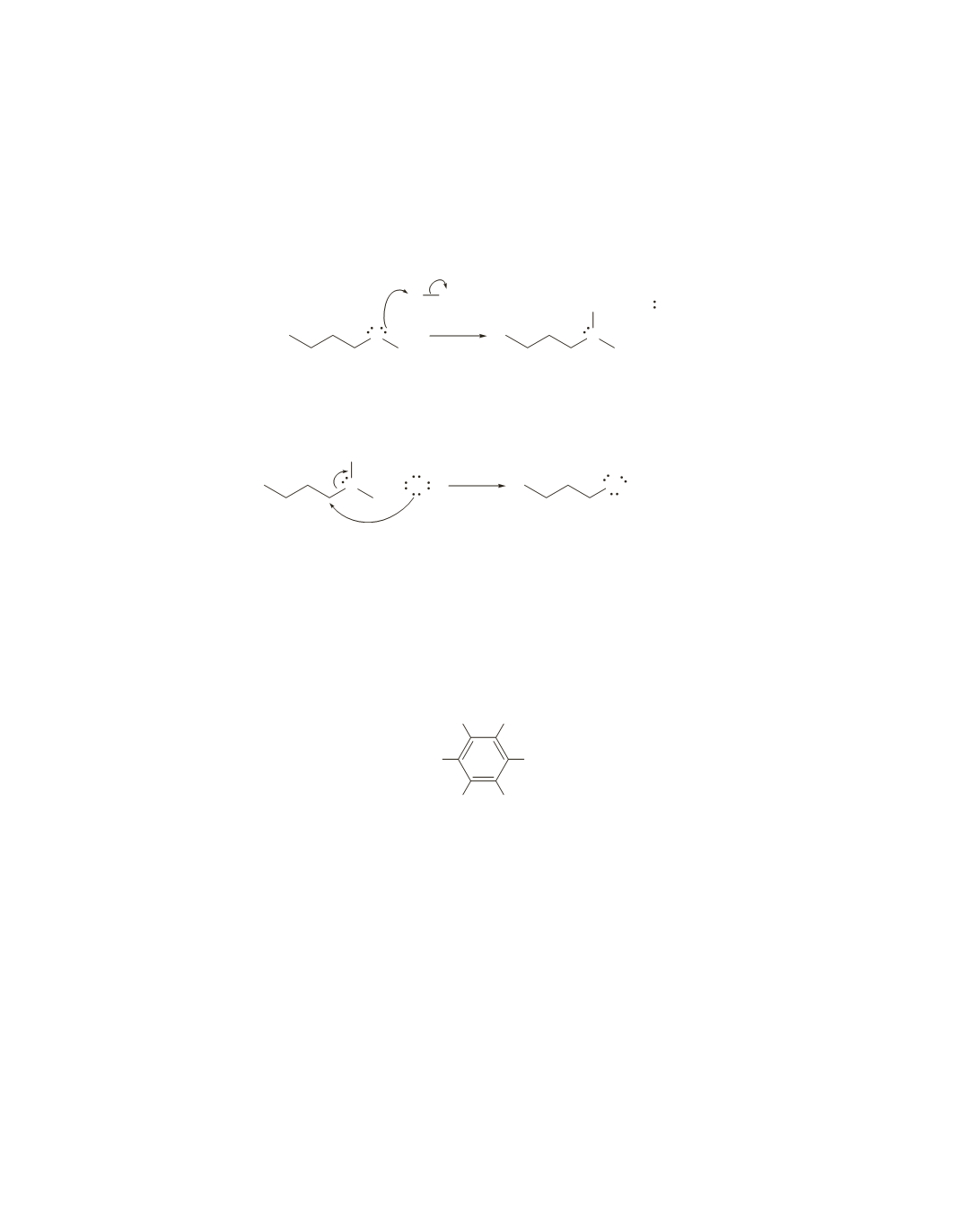
Under acidic conditions, the starting material (1-butanol) will be protonated.
O
H
H A
H
H
A
−
O
+
The protonated alcohol now has a leaving group that can be replaced by a nucleophile. Because we know
that bromine is present in the product, we can assume that bromide ion is the incoming nucleophile.
Br
−
Br
H
2
O
H
H
O
+
+
We now know that the product of the reaction is
1-bromobutane
. The acid, which must be the source of
the nucleophile, is
HBr
.
6.
The two signals near 7 and 8 ppm are due to the hydrogens of a benzene ring. Because these signals
integrate to 4 protons, the benzene ring must be disubstituted. The fact that both signals are doublets tells us
that the protons that give each signal must be coupled to one proton
(
N
+
1
=
1
+
1
=
2).
Therefore, the
substituents must be at the 1- and 4-positions.
H
d
H
c
H
d
H
c
Y
Z
By subtracting the six Cs and four Hs of the benzene ring from the molecular formula, we know that the
two substituents contain three Cs, six Hs, and three Os
(C
9
H
10
O
3
-
C
6
H
4
=
C
3
H
6
O
3
).
A triplet (1.4 ppm) that integrates to 3 protons and a quartet (4.2 ppm) that integrates to 2 protons are
characteristic of an ethyl group. Because the signal for the
CH
2
group of the ethyl substituent appears at a
relatively high frequency, we know that it is attached to an electronegative atom (in this case, an O).
The presence of the
CH
3
CH
2
O
group consumes more of the remaining molecular formula
(C
3
H
6
O
3
-
C
2
H
5
O
=
CHO
2
).
There is one remaining NMR signal, a singlet (9.8 ppm) that integrates to
1 proton.
To help with the identification, we turn to the IR spectrum. The broad absorption near
3200 cm
-
1
indicates
the
O
¬
H
stretch of an alcohol; the proton of the OH group would give the broad NMR signal at 9.8 ppm.
The strong absorption at
1680 cm
-
1
indicates the presence of a carbonyl
C
“
O
group.