


 412 / 912

404 Chapter 11
Copyright © 2017 Pearson Education, Inc.
c.
CH
3
CH CHCH
3
RCOOH
O
CH
3
CH CHCH
3
O
2. HCl
CH
3
CHCHCH
3
OH
CH
3
CH
3
CCHCH
3
CH
3
O
1. CH
3
CuLi
2
)
(
NaOCl
CH
3
COOH
0 ºC
39.
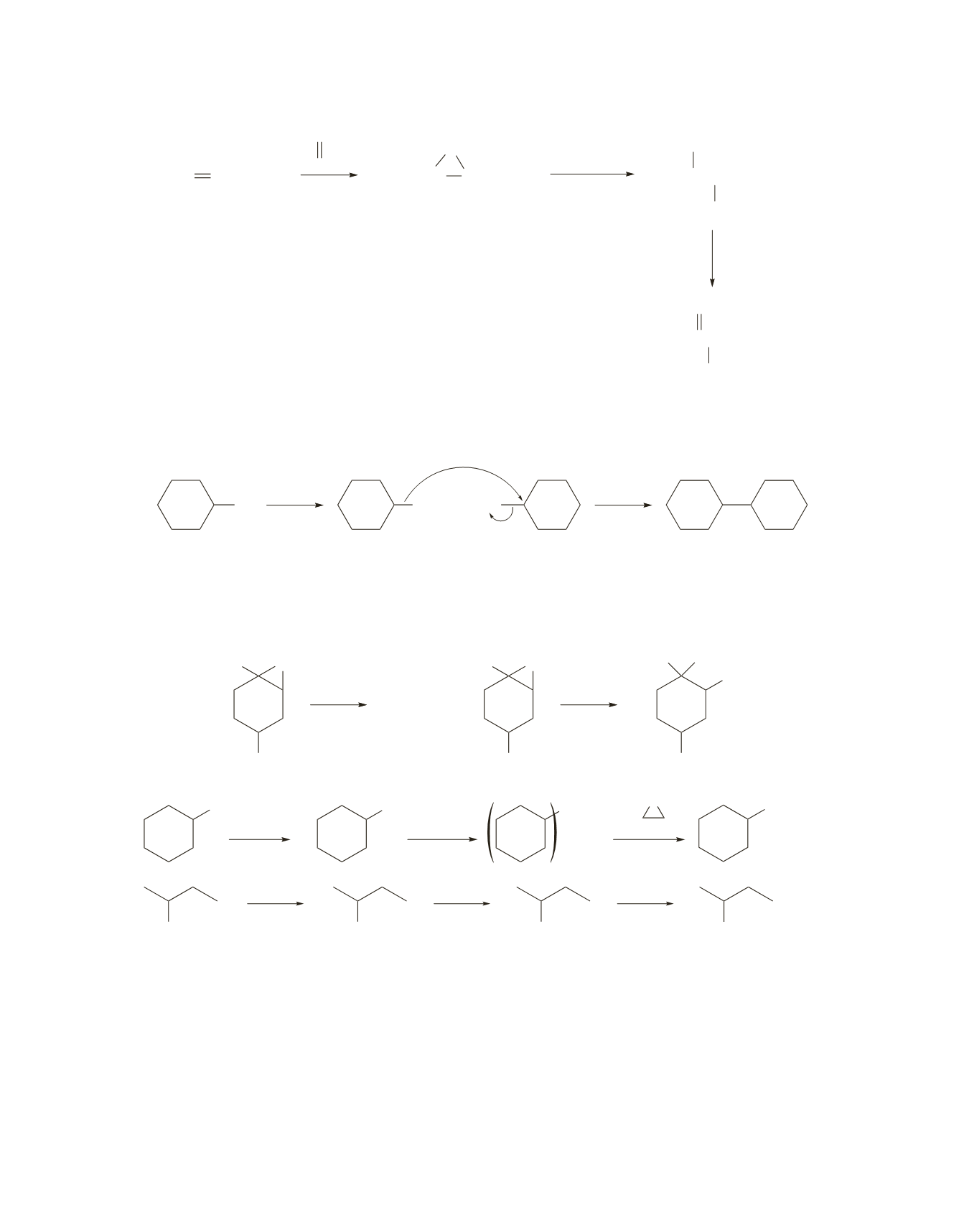
Once some bromocyclohexane has been converted to a Grignard reagent, the Grignard reagent reacts with
the bromocyclohexane that has not been converted to a Grignard reagent.
Br
Mg
MgBr
+
Br
+
MgBr
2
Et
2
O
40.
The student did not get any of the expected product, because the Grignard reagent removed a proton from
the alcohol group. Addition of HCl
>
H
2
O protonated the alkoxide ion and opened the epoxide ring.
CH
3
MgBr
+
OH
O H
3
C
CH
4
+
O
−
O H
3
C
HCl
H
2
O
OH
OH
H
3
C OH
41.
a.
OH
PBr
pyridine
3
Br
CuLi
CH
2
CH
2
OH
1.
2. HCl
O
2
1. Li
2. CuI
b.
OH
PBr
3
Br
Mg
Et
2
O
MgBr
D
2
O
D
pyridine
42.
Remember that the double bond that comes from the alkenyl-organoboron compound always has the
E
(trans) configuration.
Both double bonds in
C
have the
Z
configuration.
a. C
cannot be prepared by a Heck reaction because the double bond in the alkenyl-organoboron
compound reactant of a Heck reaction always has the
E
configuration in the product.