


 703 / 912

Chapter 20 695
Copyright © 2017 Pearson Education, Inc.
60.
O
H
H Cl
O
O
HO
HO
HO
CH
2
OH
O
HO
CH
2
OH
OH
HO
+
Cl
−
HO
HO
HO
CH
2
OH
O
HO
CH
2
OH
OH
HO
O
+
+
H
2
O
H
2
O
+
OH
H
OH
HO
HO
CH
2
OH
HO
O
+
+
HO
HO
CH
2
OH
HO
O
HO
HO
CH
2
OH
HO
O
OH
HO
HO
CH
2
OH
HO
O
H
3
O
+
-maltose
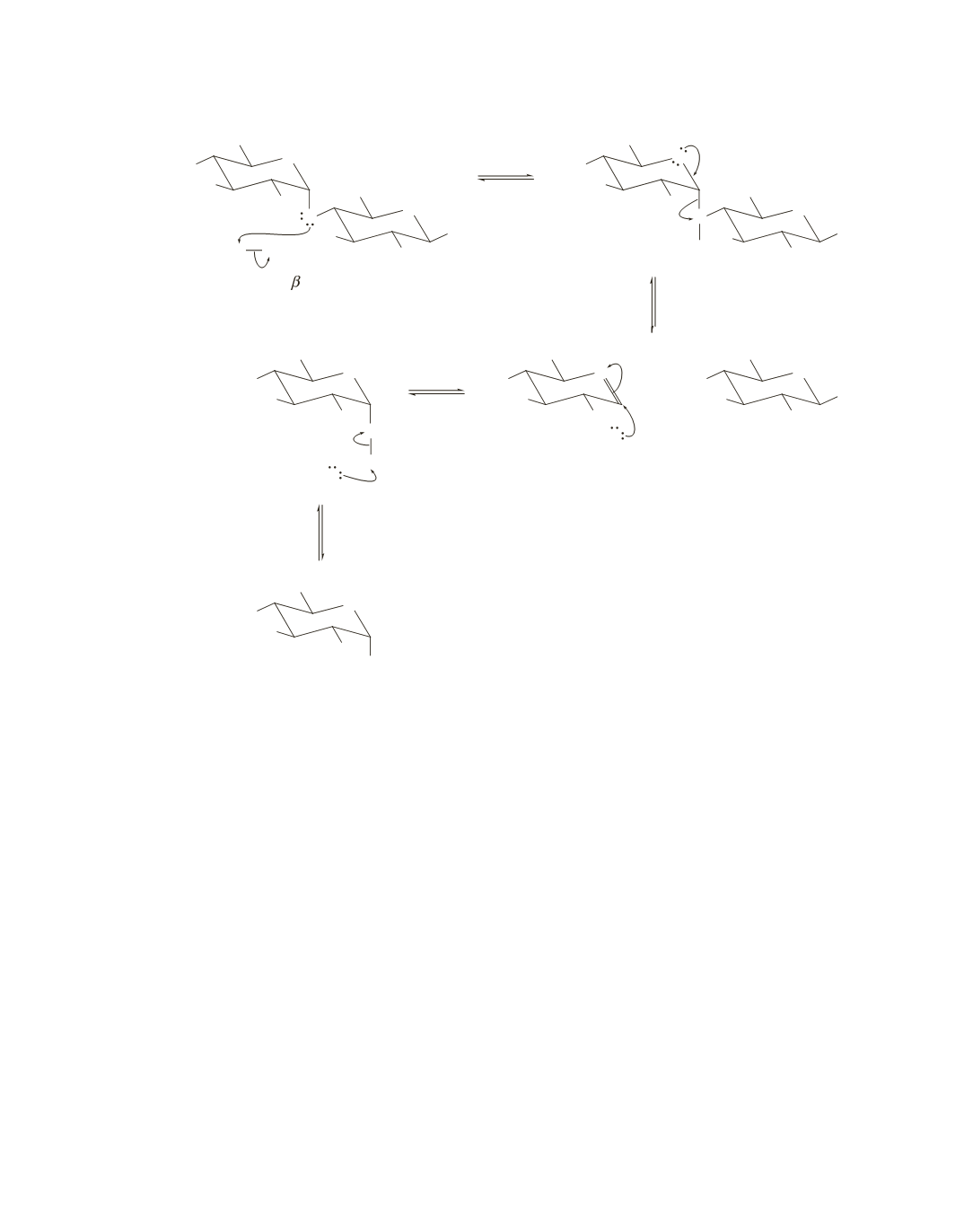
The
b
-anomer will also be formed when H
2
O adds to the top of the plane of the oxocarbenium ion.
61.
10
aldaric acids
Each of the following pairs forms the same aldaric acid:
d-allose and l-allose
l-altrose and l-talose
d-galactose and l-galactose
d-gulose and l-glucose
d-altrose and d-talose
l-gulose and d-glucose
Therefore, 12 aldohexoses form 6 aldaric acids. The other 4 aldohexoses each form a distinctive aldaric acid,
and 6
+
4
=
10.
62.
We know the hexose is a ketohexose because it does not react with Br
2
; we know it is a 2-ketohexose
because if it were a 3-ketohexose, it would not be able to form a hemiacetal (because the hemiacetal would
have an unstable four-membered ring), and, therefore, would not undergo mutarotation.