


 699 / 912

Chapter 20 691
Copyright © 2017 Pearson Education, Inc.
50.
O
HO
COOH
O
OH
the - -glucuronide
the - -glucuronide
OH
O
HO
COOH
O
OH
OH
51.
HO
H
H
H OH
OH O
OH
OH
HNO
3
A
C
B
CH
2
OH
Kiliani–Fischer
optically inactive
Wohl
degradation
C
C
O
H
H
H
H OH
OH
OH
C
O
CH
2
HNO
3
HNO
3
OH
H
H
H
H OH
H OH
OH
OH
C
O
CH
2
OH
H
HO
H
H OH
H OH
OH
H
C
O
+
HO
H
H
OH O
OH
OH
HNO
3
D
CH
2
OH
optically inactive
optically inactive
C
C
O
H
H
H OH
OH
C
O
H
H
H OH
H OH
OH
OH
C
O
OH O
C
optically active
OH O
C
HO
HO
HO
H
H OH
H OH
OH
H
C
O
+
52.
1.
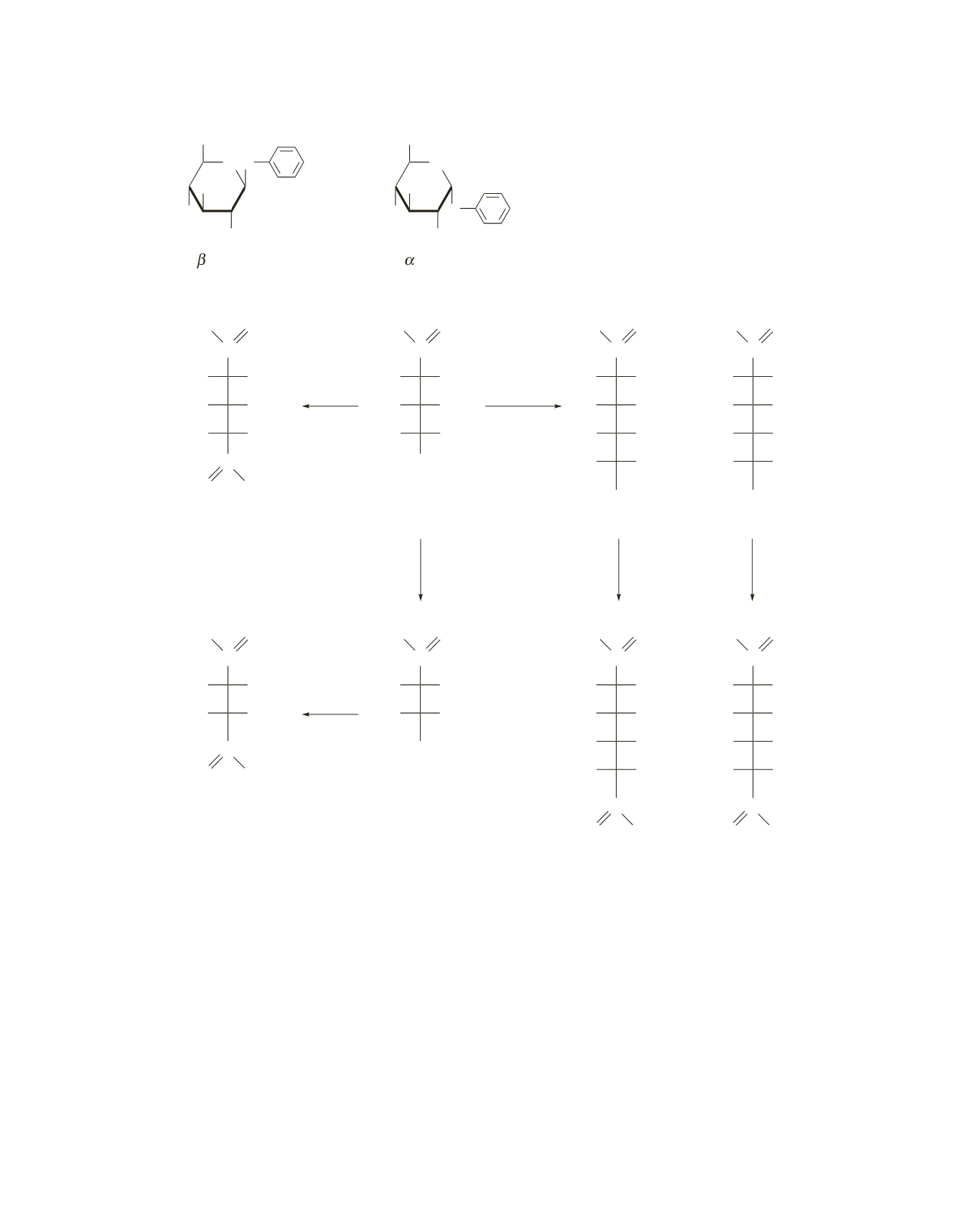
As Fischer did, we can narrow our search to eight aldohexoses because there are eight pairs of enantio-
mers. First, we need to find an aldopentose that forms
1
+
2
-galactose as a product of a Kiliani–Fischer
synthesis. That sugar is the one known as
1
-
2
-lyxose. The Kiliani–Fischer synthesis on
1
-
2
-lyxose
yields two sugars with melting points that show them to be the sugars known as
1
+
2
-galactose and
1
+
2
-talose. Now we know that
1
+
2
-galactose and
1
+
2
-talose are C-2 epimers. The eight aldohexoses
are sugars 1 and 2, 3 and 4, 5 and 6, or 7 and 8. (See page 954 of the text.)
2.
When
1
+
2
-galactose and
1
+
2
-talose react with HNO
3
,
1
+
2
-galactose forms an optically inactive
aldaric acid and
1
+
2
-talose forms an optically active aldaric acid. Therefore,
1
+
2
-galactose and
1
+
2
-talose are sugars 1 and 2 or 7 and 8. Because
1
+
2
-galactose is the one that forms the optically
inactive aldaric acid, it is either sugar 1 or 7.