



 556 / 912

548 Chapter 16
Copyright © 2017 Pearson Education, Inc.
86.
a.
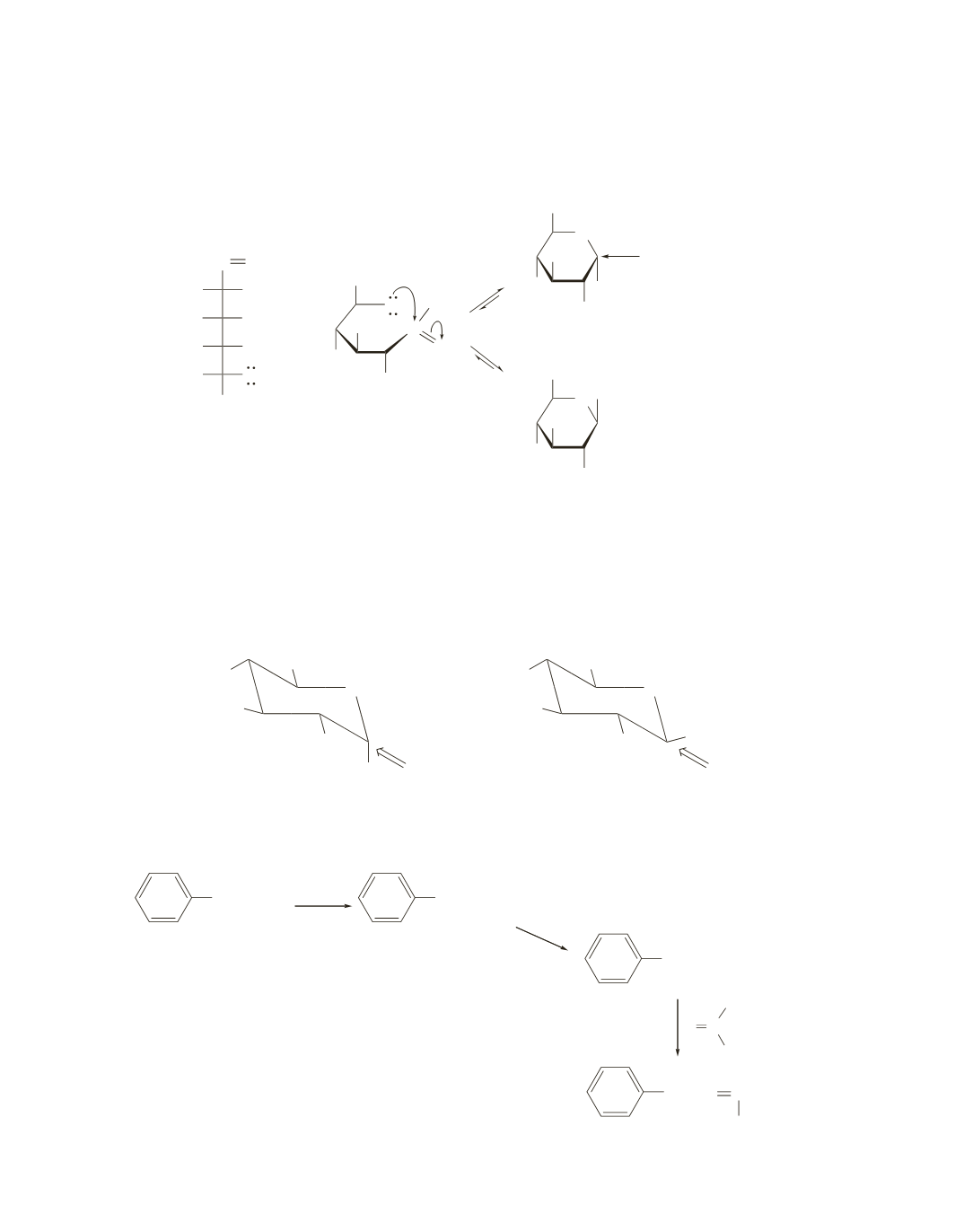
The OH group on C-5 of glucose reacts with the aldehyde group in an intramolecular reaction, forming
a cyclic hemiacetal. Because the reaction creates a new asymmetric center, two cyclic hemiacetals are
formed, one with the
R
configuration at the new asymmetric center and one with the
S
configuration.
HC
OH H
H HO
OH H
OH H
CH
2
OH
O
1
2
3
4
5
6
=
C
OH
HOCH
2
OH
HO
OH
O
H
O
HOCH
2
HO
OH
OH
OH
OH
O
HOCH
2
HO
OH
OH
1
2 3
4
5
6
new asymmetric center
b.
The two products can be drawn in their chair conformations by putting the largest group
1
CH
2
OH
2
in
the equatorial position and then putting the other groups in axial or equatorial positions depending on
whether they are cis or trans to one another. For example, the OH attached to the carbon that is next to
the carbon attached to the
CH
2
OH
group is trans to the
CH
2
OH
group. The hemiacetal on the left has
all but one of its OH groups in the equatorial position, whereas the hemiacetal on the right has all of its
OH groups in the equatorial position. Because a compound can avoid unfavorable 1,3-diaxial interac-
tions by having its substituents in equatorial positions, the hemiacetal on the right is more stable.
HO
O
OH
OH
CH
2
OH
HO
hemiacetal
less stable
HO
O
OH OH
CH
2
OH
HO
hemiacetal
more stable
87.
The alkyl bromide is 1-bromo-2-phenylethane. The molecular formula of the product of the Wittig reaction
indicates that the ketone that reacts with the phosphonium ylide has three carbons (that is, the ketone is acetone).
CH
2
CH
2
Br
P(C
6
H
5
)
3
CH
2
CH
2
P(C
6
H
5
)
3
+
CH
2
CHP(C
6
H
5
)
3
+−
O C
CH
3
CH
3
CH
2
CH CCH
3
CH
3
CH
3
(CH
2
)
3
Li