


 878 / 912

870 Answers
Copyright © 2017 Pearson Education, Inc.
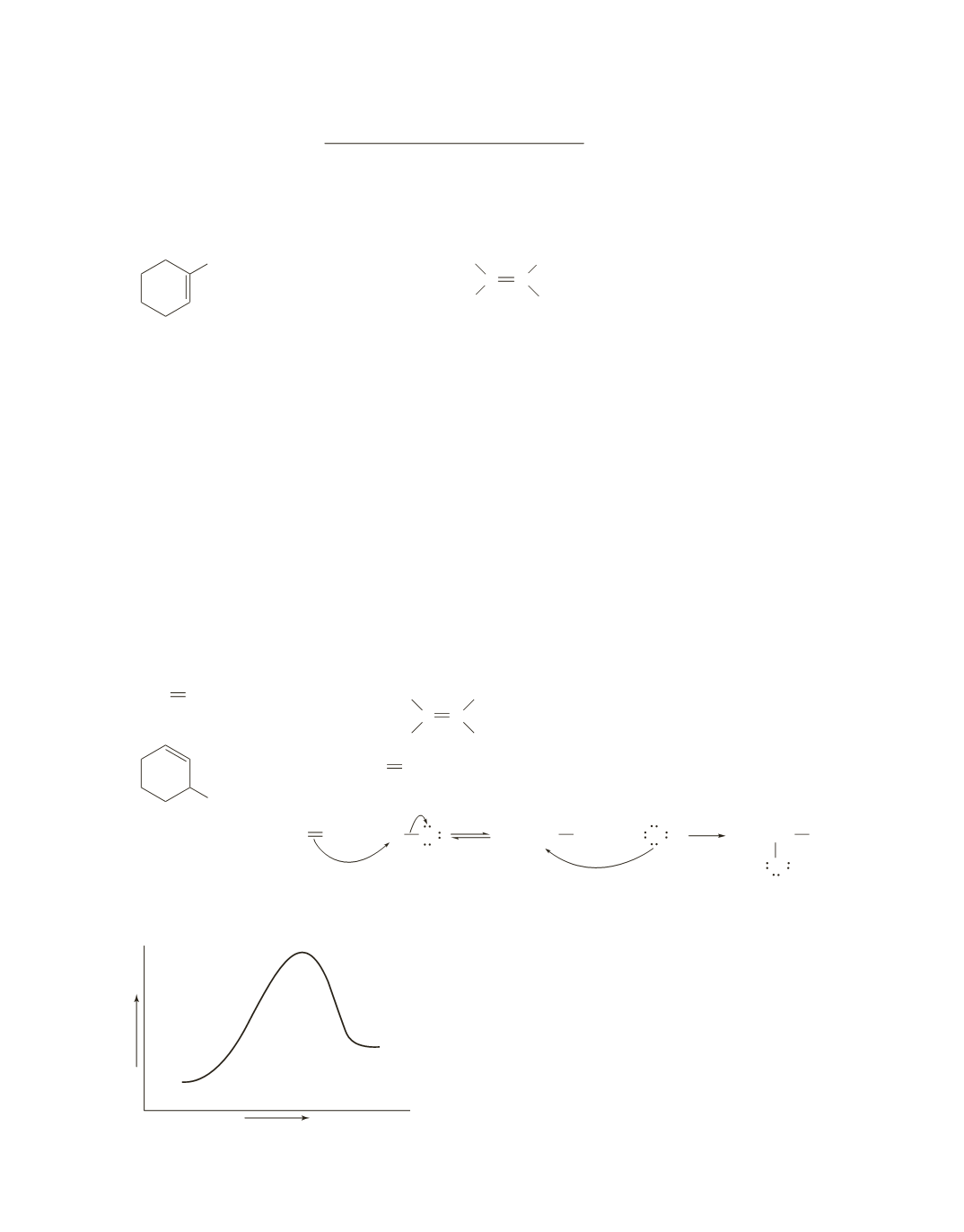
Answers to Chapter 5 Practice Test
1.
a.
4-methyl-1-hexene
c.
7-methyl-3-nonene
b.
4-bromocyclopentene
d.
4-chloro-3-methylcyclohexene
2.
a.
CH
3
b.
C C
H
H
3
C
H
CH
3
3.
a.
2-pentene
c.
3-methyl-2-pentene
b.
3-methyl-1-hexene
d.
1-methylcyclohexene
4.
a.
Increasing the energy of activation increases the rate of the reaction.
F
b.
Decreasing the entropy of the products compared to the entropy of the reactants
makes the equilibrium constant more favorable.
F
c.
An exergonic reaction is one with a
-
∆
G
°
.
T
d.
An alkene is an electrophile.
F
e.
The higher the energy of activation, the more slowly the reaction takes place.
T
f.
Another name for
trans
-2-butene is (
Z
)-2-butene.
F
g.
A reaction with a negative
∆
G
°
has an equilibrium constant greater than one.
T
h.
Increasing the free energy of the reactants increases the rate of the reaction.
T
i.
Increasing the free energy of the products increases the rate of the reaction.
F
j.
The magnitude of a rate constant is not dependent on the concentration of the reactants.
T
k.
2,3-Dimethyl-2-pentene is more stable than 3,4-dimethyl-2-pentene.
T
5.
B
6.
a.
CH
2
CHCH
2
OH
c.
C C
CH
3
CH
2
H
CH
2
CH
2
CH
3
H
b.
CH
3
d.
CH
2
CHBr
7.
5
8.
CH
3
CH CH
2
+
H Cl
CH
3
CH CH
3
+
Cl
+
−
CH
3
CH CH
3
Cl
9.
a negative
∆
H
°
,
a positive
∆
S
°
,
a high temperature
10.
a.
4 kcal/mol
b.
35
°
C
c.
one reactant forms two products
11.
Free energy
Progress of the reaction