


 889 / 912

Answers
881
Copyright © 2017 Pearson Education, Inc.
8.
23%
9.
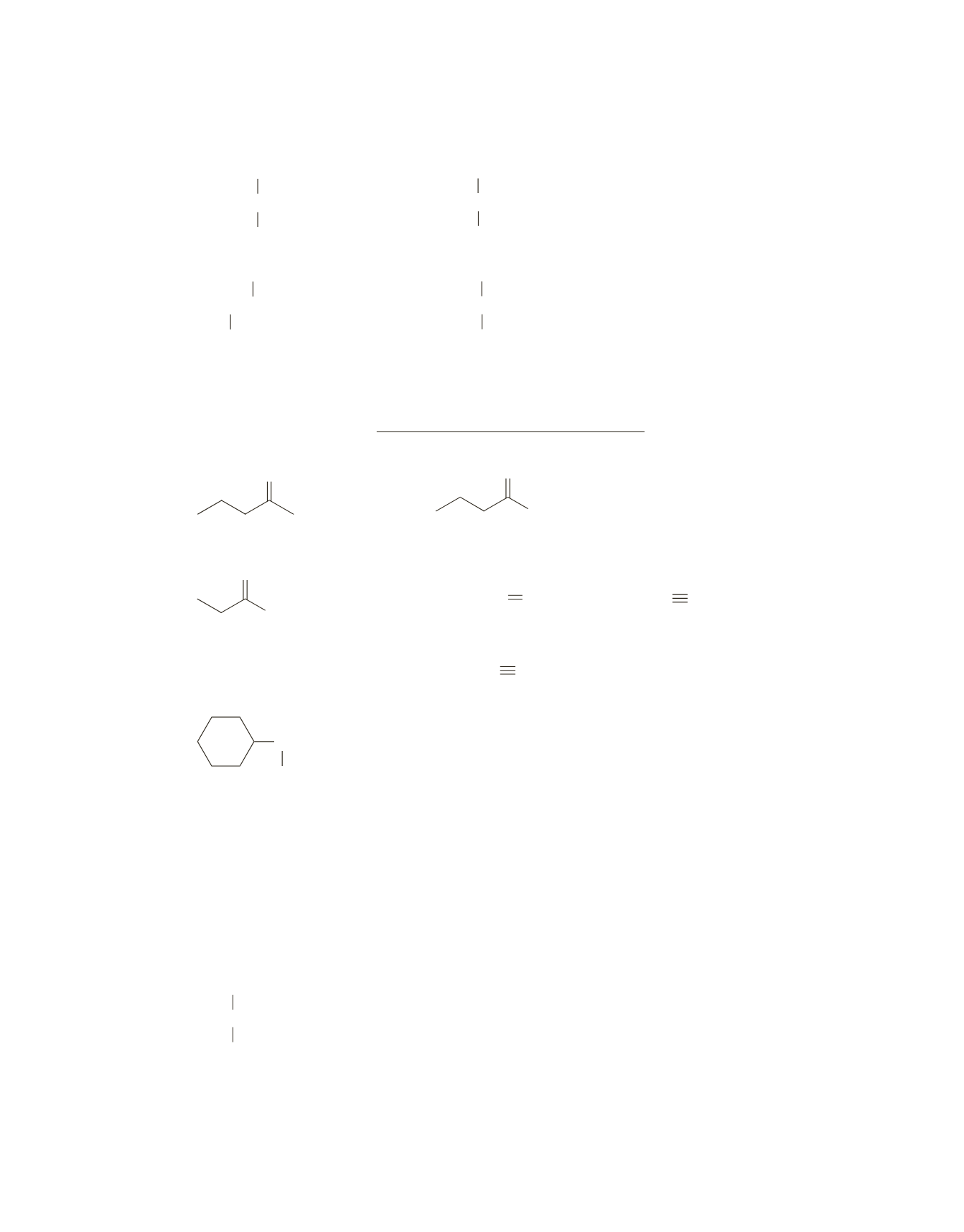
a.
CH
2
CCH
2
CH
3
CH
3
Br
CH
3
c.
CH
2
CH
3
CH
3
CH
2
C
CH
3
Cl
b.
CHCH CH
3
CH
2
CH
3
Br
CH
3
d.
CH
2
CH
3
CH
3
CH
2
C
CH
3
Cl
10.
b
Answers to Chapter 13 Practice Test
1.
a.
O
H
~2770 cm
−
1
e.
~1050 or ~1250 cm
−
1
OCH
3
O
b.
NH
2
O
~3300 cm
−
1
f.
CH
3
CH
3
2
CH CH CH CH
3 2
CH C CCH
3
~
1600
cm
−1
~
3100
cm
−1
~
2100
cm
−1
c.
CH
3
CH
2
CH
2
CH
2
OH
g.
CH
3 2
CH C CH
~3300 cm
−
1
3600
-
3200 cm
-
1
d.
CHCH
3
OH
~1380 cm
−
1
2.
a.
The O—H stretch of a concentrated solution of an alcohol occurs at a higher
frequency than the O—H stretch of a dilute solution.
F
b.
Light of 2 nm is of higher energy than light of 3 nm.
T
c.
It takes more energy for a bending vibration than for a stretching vibration.
F
d.
Propyne will not have an absorption band at
3100 cm
-
1
because there is no
change in the dipole moment.
F
e.
The
M
+
2
peak of an alkyl chloride is half the height of the M peak.
F
3.
CH
3
CH
2
CCH
2
CH
2
CH
3
CH
3
OH